
People go to work for money – we all know that. No fairy tales, no magic leaves replacing a paycheck. But people stay because they feel seen. They stay because of recognition, because someone notices their effort and says, “This mattered.”
And the latest employee recognition statistics confirm just how powerful that feeling is. Gallup’s findings show that employees who feel genuinely appreciated are up to 40% less likely compared with those who feel invisible. One simple human gesture – timely, authentic recognition – becomes a real driver of retention, engagement, and long-term loyalty.
And this is exactly why thoughtful employee recognition has become so important. Appreciation isn’t the soft skill – it’s a strategic business tool. It shapes how motivated people feel, how they show up, and whether they see their future inside your company or somewhere else.
This guide breaks down the most important employee recognition statistics of 2025, explores the psychology behind appreciation, highlights what employees value most, and shows how leading companies build recognition systems that make people want to stay.
Key employee recognition statistics you need to know
The numbers behind employee recognition are far more compelling tha most leaders expect. They show the same pattern again and again: when people feel seen, everything improves – effort, motivation, engagement, and even performance across entire teams.
Recognition boosts effort and motivation
According to the 2025 State of Recognition Report:
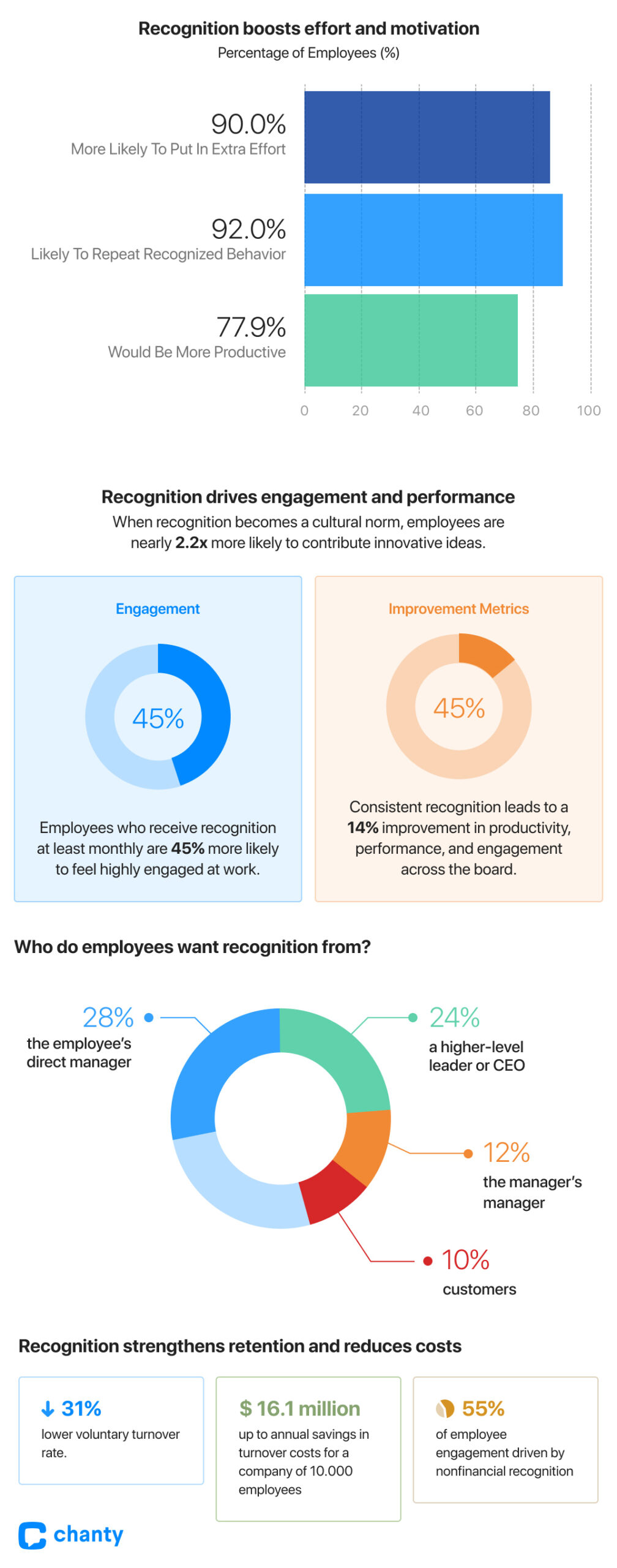
- 90% of employees say they’re more likely to put in extra effort when their work gets noticed.
- 92% say they’re likely to repeat behavior they were recognized for.
This is not just emotional – it’s behavioral science.
Even broader motivation studies agree:
- 77.9% of employees say they’d be more productive if they were recognized more often.
Demographics here matter too. Nectar’s findings show that recognition motivates certain groups especially strongly – particularly employees aged 35-44, post-graduate degree earners, and workers earning $75,000-$99,999.
Recognition drives engagement and performance
Findings from the Achiever Workforce Institute reveal that employees who receive recognition at least monthly are 45% more likely to feel highly engaged at work. This pattern is echoed in broader engagement statistics, which show that recognition correlates with measurable engagement uplift across organisations. When appreciation becomes a habit instead of an afterthought, engagement naturally rises with it.
A separate Gallup study shows that consistent recognition creates measurable gains, leading to a 14% improvement in productivity, performance, and engagement across the board.
And when recognition becomes a cultural norm, employees are nearly 2.2x more likely to contribute innovative ideas – proving that appreciation doesn’t just maintain performance, it elevates it.
Recognition strengthens retention and reduces costs
Recognition has a powerful impact on turnover. Companies with strong recognition programs see a 31% lower voluntary turnover rate, according to a SHRM interview with Disruptive HR. People stay longer where their contributions are seen and valued.
The financial impact is huge. A company of 10.000 employees can save up to $16.1 million annually in turnover-related costs simply by building a culture that consistently rewards great work.
A McKinsey report adds that up to 55% of employee engagement is driven by nonfinancial recognition – making it one of the biggest drivers of employee experience and long-term loyalty.
Who do employees want recognition from?
Gallup’s research shows that the most memorable recognition comes from:
- the employee’s direct manager (28%)
- a higher-level leader or CEO (24%)
- the manager’s manager (12%)
- customers (10%)
Recognition from peers is also more common than many expect: 63% of employees say they receive peer recognition at least weekly.
Yet paradoxically, 28% of employees never receive recognition from their CEO or executive team – a missed opportunity for impactful leadership.
The recognition gap inside the companies
While 70% of employees believe their employer cares about recognition, only 34% say their company actually has a recognition program. This gap highlights why so many appreciation efforts fall flat.
Meanwhile, HR professionals see things differently: 80% say their rewards programs are effective, and 72% feel the same about recognition. But the employee viewpoint shows that many of these programs aren’t reaching people consistently enough to make a difference.
According to SHRM, structured recognition programs also bring down workplace frustration by 28.6% – proving that recognition helps reduce burnout and resentment before they build.
Recognition strengthens culture and team performance
When recognition becomes part of everyday culture, employers are nearly 2x more likely to rate their team’s performance as excellent.
And companies that invest wisely see major business gains. A study by Bersin&Associates found that organizations spending 1% or more of payroll on recognition achieve their business goals at a rate 79% higher than companies investing less.
The psychology behind employee appreciation
If you peel back the layers of why recognition matters so much, you’ll find it tied to something fundamental: people want to matter. They want to feel that who they are and what they do has weight. And long before employee surveys and workplace studies proved it, psychology had already mapped this truth.
How recognition meets core human needs
According to Maslow’s hierarchy of needs, appreciation plays a defining role once basic needs like safety and stability are met. From there, humans naturally seek connection, esteem, and purpose – three areas where employee recognition delivers its strongest impact.
- Belonging: “I’m part of something bigger”
Being acknowledged signals that you’re accepted and valued within your group. It strengthens trust and psychological safety – cornerstones of any healthy team. When people feel they belong, they stop operating in survival mode and start contributing in meaningful ways.
- Esteem: “What I do matters”
Recognition satisfies the human need for esteem by affirming competence, effort, and impact. It’s also why “vague compliments” rarely work. The brain responds to specific, earned appreciation – it reinforces mastery and gives people a clear sense of progress.
- Purpose: “This is where I’m meant to be”
At the top of Maslow’s pyramid sits self-actualization: the drive to reach one’s potential and do work that feels meaningful.
Thoughtful recognition fuels that drive. It connects daily tasks to the bigger picture and tells employees. Your work isn’t just done – it’s needed.
Every genuine acknowledgment triggers dopamine, motivating employees to keep improving and engaging fully.
Why appreciation matters more in high-pressure work environments
The modern workplace is fast, demanding, and often unpredictable. Employees juggle shifting priorities, emotional load, and the constant expectation to perform.
In this environment, job satisfaction and well-being become critical not only for personal fulfilment but also for organizational health.
Research on employee recognition statistics consistently shows that when workers feel appreciated:
- Their stress decreases
- Their productivity increases
- Their engagement strengthens
- Their loyalty grows
Recognition becomes a stabilizer – a signal that their effort is seen even when the pace is relentless.
Is employee recognition an intrinsic motivator?
Absolutely.
Workplace studies, including the findings referenced by Gallup and research published in the National Institutes of Health, identify recognition as a powerful intrinsic motivator. It does more than prevent dissatisfaction – it actively fosters satisfaction, drives performance, and strengthens engagement.
Recognition energizes people from the inside out. It validates their contribution, encourages continuous improvement, and helps them see the meaning behind their work.
How recognition strengthens retention
Recognition reduces uncertainty about whether an employee is valued or wanted – two main emotional drivers behind turnover. When people feel seen, their sense of belonging deepens, and so does their desire to stay.
Studies also show that job satisfaction often acts as a mediator between recognition and retention. When appreciation boosts psychological well-being, employees feel more content, more anchored, and more committed to their organization.
In other words: recognition improves satisfaction, and satisfaction improves retention.
Why peer recognition is so powerful
Peer recognition creates a cycle of mutual support that many top-down programs fail to generate. When teammates acknowledge each other’s work:
- camaraderie grows
- trust strengthens
- morale rises
- engagement improves
Research shows that peer-to-peer appreciation can even drive stronger, more sustained engagement than delayed managerial recognition, because it’s immediate, specific, and rooted in everyday collaboration.
How values-based recognition shapes company culture
When recognition is aligned with company values, it becomes more than praise – it becomes cultural reinforcement.
It teaches employees what behaviors matter, helps them internalize the mission, and encourages them to celebrate both major achievements and small, essential wins.
Values-based recognition creates a workplace where people don’t just work – they belong, grow, contribute, and feel part of something meaningful.
What employees value the most in 2025
If you still think employees stay because of the money, every major study from the last two years says otherwise, and the numbers are impossible to ignore.
The Randstad Workmonitor Report 2025 shows:
- Work-life balance (85%) is now the #1 factor in whether employees stay or leave
- For the first time in the report’s 22-year history, balance outranked pay
Modern employees aren’t loyal to salaries – they’re loyal to the quality of their lives.
People want work that supports who they are, not work that consumes them. And when you look closely, the things employees value most today reflect deep human priorities: security, meaning, flexibility, appreciation, and belonging.
One of the most powerful ways to fulfill these needs is through non-financial rewards – also called intangible or intrinsic incentives. These are gestures of recognition and appreciation that don’t involve money. They can be as simple as a heartfelt thank-you, a certificate of achievement, a public shout-out, or even flexible work arrangements.
When designed thoughtfully, these rewards do more than make employees feel good. They boost engagement, reinforce loyalty, and give employees a clear sense of purpose. The most effective programs combine recognition with opportunities for growth, connection, and meaning, creating a workplace where employees feel genuinely valued every day.
Here are the values employees prioritize most and how some leading companies bring them to life through practical recognition programs.
1. Visibility and appreciation
Employees want their effort to be seen – intentionally and often.
- Salesforce integrates “shout-outs” into weekly team rituals, encouraging managers to start meetings with recognition, share wins on internal channels, and spotlight contributions across departments.
This kind of public appreciation builds a culture where effort doesn’t disappear into the noise.
2. A sense of collaboration
Workers value environments where peers notice and support each other.
- Google’s gThanks and peer-bonus systems allow employees to publicly thank colleagues and nominate them for impactful work.
Peer-to-peer recognition is strongly linked to stronger team cohesion and higher engagement, according to multiple workplace psychology studies.
3. Meaningful manager relationships
Employees stay where leadership sees and understands their work.
- Microsoft has normalized weekly 1:1 conversations that connect individual effort to strategic goals.
This kind of consistent acknowledgment builds trust – still a top predictor of retention according to the Edelman Trust Barometer 2024.
4. Achievement that feels tangible
Employees value milestones that feel “real,” not symbolic.
- Google reinforces progress with internal awards, badges, and ceremonies that highlight both big and small wins.
5. Growth and development
The ability to grow has become a core form of recognition.
- IBM uses digital badges, mentorship tracks, and “Rising Champion” programs to elevate employee expertise and reward contribution through development.
LinkedIn’s 2024 Workforce Learning Report shows that employees stay longer at companies that invest in their growth.
6. Flexibility and work-life balance
Flexibility is now interpreted as respect – a powerful form of recognition.
- Spotify offers a globally flexible “Work From Anywhere” policy that gives employees control over how and when they work.
Hybrid and flexible policies are now the #1 factor behind job satisfaction worldwide. You can check the best work-life balance countries.
7. Recognition of small wins
Micro-recognition matters just as much as annual awards.
- Adobe uses tools like “bravos” and milestone celebrations to reward everyday contributions, not just major achievements.
Consistent micro-recognition is associated with stronger morale, reduced burnout, and higher daily engagement.
8. Belonging and team visibility
Employees want to feel part of something bigger than their tasks.
- Companies using platforms like Workhuman showcase achievements on social-style feeds, creating a shared space where contributions feel visible and celebrated.
Public acknowledgment fuels belonging, one of the strongest predictors of performance.
9. Having a voice
Being heard is recognition in itself.
- Many large employers run idea programs, internal suggestion platforms, or “Voice of Employee” initiatives where staff contribute solutions and get credited for them.
According to Salesforce State of the Connected Workplace, employees who feel heard are 4.6× more likely to feel empowered to perform their best.
10. Alignment with values
People want to work where their effort supports a shared purpose.
- Zappos rewards employees who live out company values through peer nominations and value-based awards.
Recognition tied to company values increases cultural alignment and drives retention, as highlighted in Deloitte Human Capital Trends 2024).
Across all these examples, one insight is impossible to ignore: Employees stay where they feel seen.
Recognition isn’t a “perk” – it’s a daily experience that shapes loyalty, motivation, and well-being. When appreciation is visible, specific, and connected to meaningful values, people don’t just work harder; they work happier. And they stay because they want to, not because they have to.
How to build your own employee recognition strategy
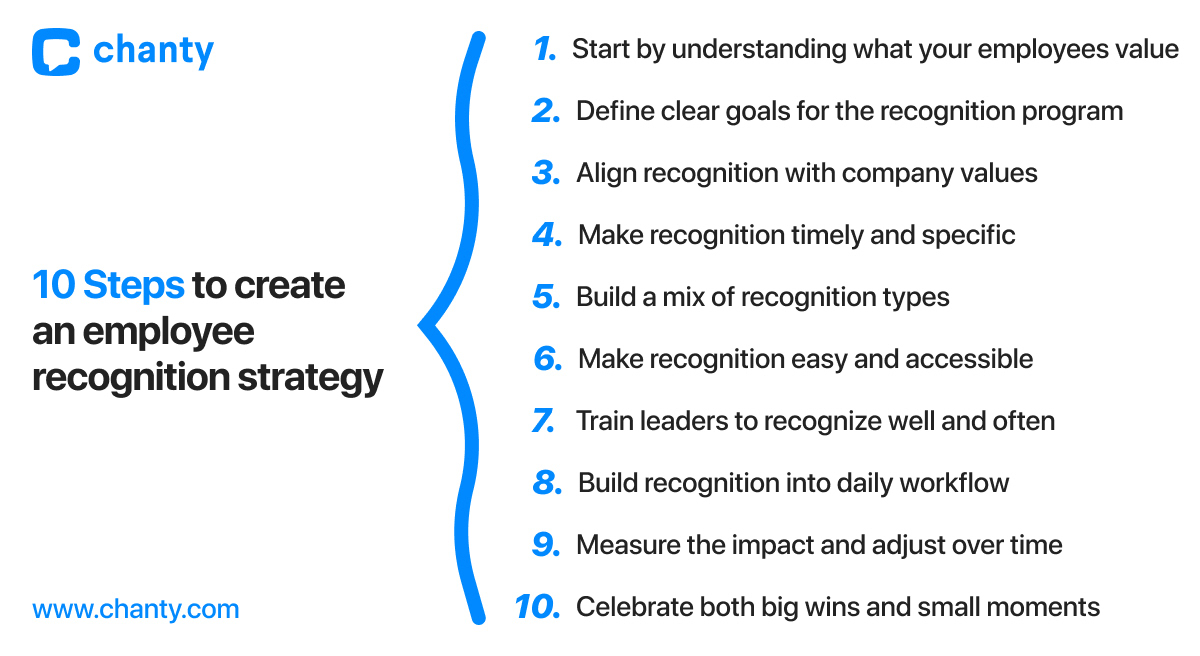
Creating an employee recognition strategy isn’t about adding perks or handing out praise at random. It’s about designing a system that makes people feel seen every day – consistently, authentically, and in alignment with what your company stands for.
Here’s how to build a program that actually works:
1. Start by understanding what your employees value
Every team is different. Before designing any recognition program, ask employees what kind of appreciation feels meaningful to them.
Some prefer public praise; others value private acknowledgment, flexibility, or development opportunities.
When you build your strategy around real preferences, recognition becomes relevant – not performative.
2. Define clear goals for the recognition program
A strong recognition strategy answers simple but essential questions:
- What behaviors are you trying to reinforce?
- What outcomes do you want to improve?
- How will recognition support your culture?
If the goal is engagement, your approach will look different than if the goal is retention, performance, or innovation.
3. Align recognition with company values
Recognition lands deeper when it reflects the company’s mission and identity.
Tie every shout-out, award, or appreciation moment to a core value.
This makes recognition not just praise – but cultural reinforcement.
4. Make recognition timely and specific
Late or vague praise loses impact.
Employees respond best when recognition:
- Happens close to the moment of achievement
- Names the specific action or behavior
- Shows the real impact of their effort
This is what turns appreciation into a clear signal: “This mattered – keep going.”
5. Build a mix of recognition types
A great strategy blends multiple forms of appreciation, not just one. Consider a structure like:
- Peer-to-peer recognition for collaboration and daily wins
- Manager recognition for performance, growth, and milestones
- Public recognition for visibility and cultural alignment
- Private appreciation for personal, meaningful moments
- Non-financial rewards that reinforce intrinsic motivation
- Flexible or growth-based perks that support long-term satisfaction
- A multi-layered approach meets more needs and reaches more people.
6. Make recognition easy and accessible
Employees will use recognition tools only if they’re simple.
Use platforms that make it effortless to send shout-outs, award points, write notes, or celebrate wins in real time.
The faster employees can express appreciation, the more frequently they’ll do it.
7. Train leaders to recognize well – and often
Managers set the tone.
Provide them with practical guidance on:
- How to give meaningful feedback
- How to connect appreciation to goals and values
- How to recognize consistently, not just during reviews
When leaders recognize effort effectively, the culture follows.
8. Build recognition into daily workflow
Recognition shouldn’t feel like an add-on.
Make it part of meetings, stand-ups, project wrap-ups, dashboards, chat platforms, and team rituals.
The more it blends into everyday rhythms, the stronger the culture becomes.
9. Measure the impact and adjust over time
Track what works, and what doesn’t, using:
- Engagement surveys
- Pulse-checks
- Peer feedback
- Turnover metrics
- Participation rates in recognition tools
A recognition strategy isn’t static. The best programs evolve with your people.
10. Celebrate both big wins and small moments
Grand accomplishments deserve spotlight – but everyday effort deserves acknowledgment, too.
When people feel noticed not only for the big milestones, but also for the small daily contributions, loyalty strengthens and culture thrives.
How team collaboration tools make recognition natural
Employee recognition is no longer confined to annual reviews or end-of-quarter meetings. It’s digital, real-time, and part of the everyday workflow. Team collaboration tools like Chanty make continuous recognition not just possible, but incredibly easy.
Here’s how these tools turn appreciation into a natural daily habit:
- Instant shout-outs: Quick messages highlight contributions in real time
- Peer-to-peer kudos: Public acknowledgment builds camaraderie and trust.
- Channels for wins: Dedicated threads or boards for achievements increase visibility.
- Emoji reactions: Celebrate successes quickly and playfully.
- Async recognition: Remote or distributed teams can recognize achievements anytime.
- Pinned messages: Kep recognition visible and ongoing
In other words, recognition doesn’t have to wait for annual reviews – it becomes part of the daily rhythm of collaboration.
Wrapping up
In the end, employee recognition isn’t a “nice-to-have” – it’s the quiet force that keeps people grounded, motivated, and genuinely connected to their work. Yes, salaries open the door. Benefits sweeten the deal. But feeling seen, valued, and appreciated? That’s what makes people stay, contribute their best, and grow roots inside a company.
Modern employees aren’t hiding what they want anymore. They’re telling us clearly, in every recent survey and every workplace trend:
“I want to feel respected. I want balance. I want purpose. I want to know my work matters.”
Recognition is the bridge between those expectations and the reality companies create every day. And the best part? You don’t need a huge budget or a Silicon-Valley-style rewards system to make recognition work. You just need intention, consistency, and the willingness to build a culture where achievements – big or small – don’t go unnoticed.
Organizations that make recognition a daily habit see the payoff across every metric that matters: lower turnover, higher productivity, stronger engagement, and healthier workplace relationships. Recognition becomes part of the rhythm of work, not an afterthought, creating teams that trust each other, leaders people want to follow, and a workplace with a heartbeat.
And for modern teams, tools like Chanty make this simple and measurable. With dedicated recognition channels, reactions, voice messages, and transparent communication, you can track and amplify recognition in real time, ensuring every contribution is noticed and celebrated. The statistics are clear: recognition isn’t just nice – it works.